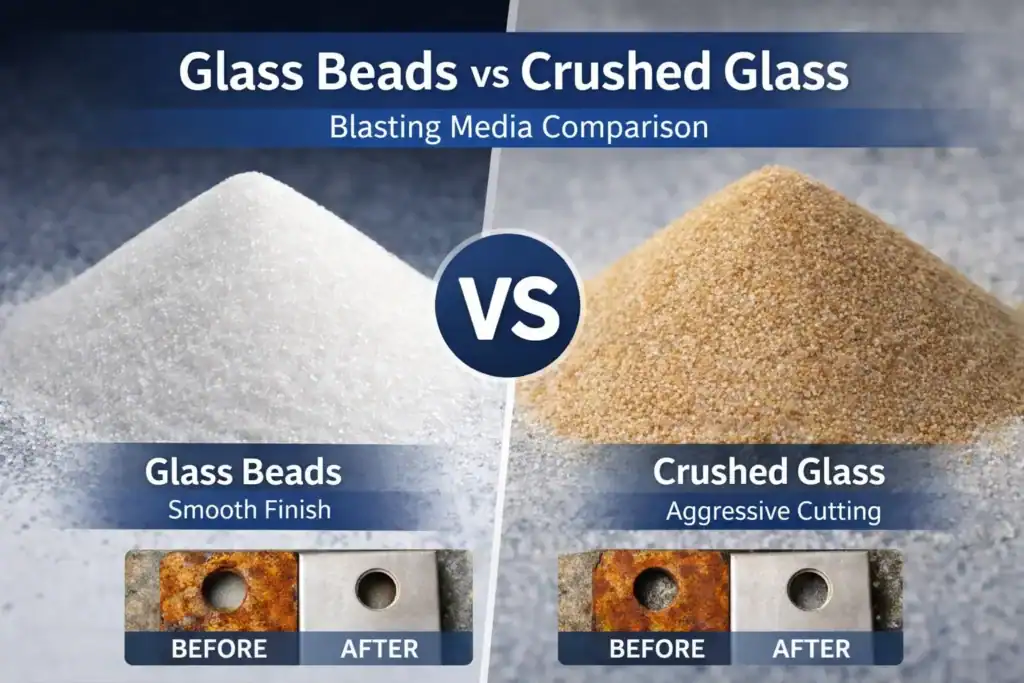
When it comes to abrasive blasting and surface preparation, selecting the right blasting media can significantly impact productivity, cost, and final surface quality. Two of the most widely used media types in modern blasting operations are Abrasive Glass Beads and Crushed Glass Abrasive.
Both materials are manufactured from glass, but their performance characteristics, surface finishes, and applications differ greatly. Understanding these differences helps industries choose the right abrasive media for cleaning, finishing, coating preparation, and restoration projects.
At Trident Abrasive, we manufacture and supply high-quality Glass Beads, Aluminum Oxide, and Crushed Glass, along with a wide range of blasting media designed for industrial and commercial applications worldwide.
This comprehensive guide compares Glass Beads vs Crushed Glass, covering:
- Key differences
- Performance comparison
- Surface finish quality
- Cost efficiency
- Environmental impact
- Industrial applications
- Selection guidelines
What Are Abrasive Glass Beads?
These spherical blasting media are manufactured from high-quality glass. The particles are smooth and round, which allows them to gently clean and polish surfaces without aggressive cutting.
Glass beads are widely used in applications where maintaining the base material integrity is critical.
Key Characteristics :
- Shape: Smooth and spherical
- Action: Gentle cleaning and polishing
- Finish: Smooth satin or matte finish
- Dust Generation: Low
- Reusability: High
- Surface Damage Risk: Minimal
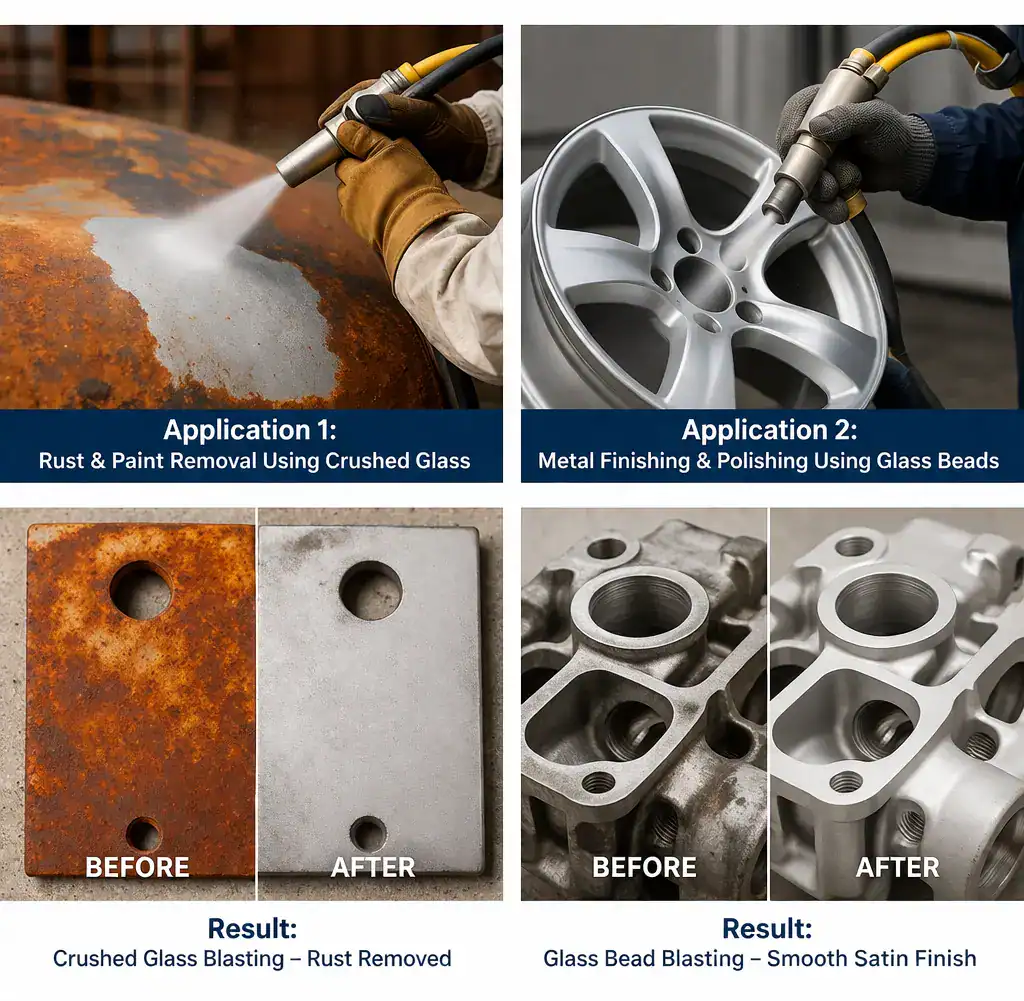
Because of their round shape, glass beads are polished rather than cut, making them ideal for delicate applications such as deburring and cosmetic finishing.
Glass beads are considered less aggressive and are commonly used for softer metals like aluminum and brass, where surface preservation is essential.
What Is Crushed Glass Abrasive?
It is manufactured by grinding recycled glass into angular particles. These sharp edges make crushed glass more aggressive than glass beads.
It is widely used for removing heavy coatings, rust, and contaminants.
Key Characteristics :
- Shape: Angular and sharp
- Action: Aggressive cutting
- Finish: Rough profile
- Dust Generation: Moderate
- Reusability: Moderate
- Surface Damage Risk: Higher than beads
Crushed glass particles have sharp edges that enable effective removal of paint, rust, and heavy coatings.
It also produces a textured surface profile that improves coating adhesion.
Complete Abrasive Media Comparison
| Feature | Glass Beads | Crushed Glass |
| Particle Shape | Round | Angular |
| Aggressiveness | Low | High |
| Surface Finish | Smooth / Satin | Rough / Etched |
| Best Use | Polishing & finishing | Coating removal |
| Reusability | High | Moderate |
| Dust Level | Low | Moderate |
| Cost Efficiency | Moderate | High |
| Surface Profile | Shallow | Deep |
| Cleaning Strength | Light to Medium | Medium to Heavy |
Key Differences Between Two Media
1. Particle Shape and Cutting Action
The most significant difference lies in particle geometry.
- Glass Beads: Smooth spherical particles
- Crushed Glass: Sharp, irregular fragments
Angular crushed glass creates a stronger abrasive action because its sharp edges cut into surfaces efficiently.
Glass beads, on the other hand, gently impact surfaces, making them ideal for polishing applications.
2. Surface Finish Quality
Surface finish requirements often determine media selection.
Glass Beads Finish
- Smooth matte finish
- Uniform surface appearance
- Cosmetic-quality finish
This is why glass beads are widely used for decorative and finishing work.
Glass bead blasting leaves smoother surfaces than most angular abrasives because of the beads’ round shape.
Crushed Glass Finish
- Rough profile
- Strong coating adhesion
- Improved paint bonding
This rough profile makes crushed glass suitable for industrial surface preparation.
3. Cleaning Strength and Efficiency
Crushed glass is significantly more aggressive than glass beads.
It is commonly used to remove:
- Rust
- Paint
- Heavy coatings
- Marine buildup
Crushed glass offers high cutting efficiency due to its sharp edges.
Glass beads are better suited for:
- Light cleaning
- Deburring
- Finishing work
4. Reusability and Durability
Glass beads can be reused multiple times without losing their shape.
Crushed glass tends to break down faster during blasting.
Crushed glass generally has lower reusability than glass beads due to particle breakdown.
5. Cost Efficiency
Crushed glass is usually more economical, especially for large-scale blasting operations.
This is because:
- It is made from recycled glass
- It requires less material due to cutting efficiency
Crushed glass is often considered cost-effective due to its lower density and reduced material consumption.
6. Dust Generation and Safety
Dust generation varies between media types.
- Glass Beads: Produce less dust
- Crushed Glass: Produce more dust
Lower dust production makes glass beads suitable for indoor blasting environments.
7. Environmental Impact
Both media types are environmentally friendly.
Crushed glass is often produced from recycled glass waste, reducing landfill use and supporting sustainability initiatives.
Applications of Glass Beads
Glass beads are widely used in finishing applications requiring smooth surfaces.
Common Uses
- Deburring metal components
- Surface polishing
- Stainless steel finishing
- Aluminum cleaning
- Mold cleaning
- Automotive restoration
- Aerospace finishing
- Cosmetic metal finishing
Glass beads are especially suitable for delicate materials where surface preservation is critical.
Applications of Crushed Glass
Crushed glass is widely used in heavy-duty cleaning applications.
Common Uses
- Rust removal
- Paint stripping
- Surface preparation
- Marine maintenance
- Bridge restoration
- Concrete cleaning
- Industrial blasting
- Coating removal
Crushed glass is particularly effective in removing tough coatings and corrosion.
Advantages of Glass Beads
✔ Smooth surface finish
✔ Minimal surface damage
✔ High reusability
✔ Low dust generation
✔ Ideal for polishing
Glass beads provide controlled cleaning while maintaining material integrity.
Advantages of Crushed Glass
✔ Strong cutting action
✔ Cost-effective blasting
✔ Improved coating adhesion
✔ Eco-friendly production
✔ Efficient rust removal
Crushed glass offers aggressive cleaning performance suitable for industrial use.
Limitations of Glass Beads
- Not suitable for heavy coating removal
- Slower cleaning speed
- Limited surface profiling capability
Glass beads are less effective against heavy corrosion and thick coatings.
Limitations of Crushed Glass
- Higher dust production
- Rougher surface finish
- Lower reusability
- Not ideal for delicate parts
These factors must be considered before selecting blasting media.
How to Choose Between Two Abrasive Media
Selecting the right media depends on project requirements.
Choose Glass Beads If:
- A smooth finish is required
- Surface polishing is needed
- Material is delicate
- Cosmetic appearance matters
Choose Crushed Glass If:
- Rust removal is required
- Heavy coating removal is needed
- Surface profiling is required
- Industrial cleaning is involved
Glass Beads vs Crushed Glass: Performance Comparison Table
| Criteria | Glass Beads | Crushed Glass |
| Finish Quality | Excellent | Moderate |
| Cutting Strength | Low | High |
| Productivity | Moderate | High |
| Surface Protection | High | Moderate |
| Media Life | Long | Shorter |
| Environmental Impact | Good | Excellent |
Why Choose Trident Abrasive for Glass Beads and Crushed Glass?
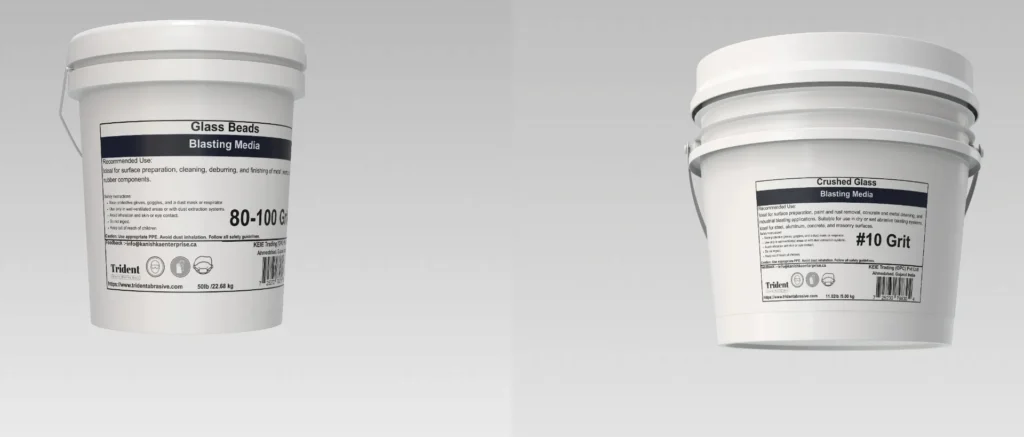
Please visithttps://tridentabrasive.com/abrasive-sandblasting-media/ for more information about the product
At Trident Abrasive, we specialize in manufacturing and supplying high-quality abrasive media tailored to industrial performance requirements.
Our Core Products Include:
- Glass Beads
- Crushed Glass Abrasive
- Aluminum Oxide
- Garnet
- Steel Shot & Steel Grit
- Ceramic Media
- Plastic Media
We offer:
✔ Consistent particle quality
✔ Export-grade packaging
✔ Custom grit sizes
✔ Bulk and retail packaging options
✔ Global supply capability
Whether your application requires polishing precision or aggressive surface preparation, Trident Abrasive provides reliable blasting solutions trusted across industries.
Industry Applications Served by Trident Abrasive
Our abrasive solutions are widely used in:
- Automotive Manufacturing
- Aerospace Engineering
- Shipbuilding
- Construction
- Oil & Gas
- Metal Fabrication
- Industrial Maintenance
- Surface Preparation
Future Trends in Glass Abrasive Media
Modern industries are increasingly moving toward:
- Eco-friendly abrasives
- Recyclable materials
- Low-dust blasting solutions
- High-efficiency media
Crushed glass and glass beads are expected to remain key materials in sustainable surface preparation technologies.
Frequently Asked Questions (FAQ)
Is crushed glass more aggressive than glass beads?
Yes. Crushed glass has sharp edges that create stronger cutting action, making it more effective for removing heavy coatings and rust.
Do glass beads damage metal surfaces?
No. Glass beads are designed to gently clean and polish surfaces without significant damage.
Which media is better for rust removal?
Crushed glass is typically better for rust removal due to its aggressive cutting ability.
Are glass beads reusable?
Yes, glass beads have high reusability and can be recycled multiple times before breaking down.
Which media is more cost-effective?
Crushed glass is generally more cost-effective for large-scale blasting projects.
Both are powerful blasting media, but they serve different purposes.
- Glass Beads are ideal for polishing and finishing
- Crushed Glass is best for heavy cleaning and coating removal
Understanding these differences helps businesses select the most effective media for their operations.
With decades of expertise in abrasive media manufacturing and supply, Trident Abrasive continues to deliver reliable, high-performance solutions for industries worldwide.
Proper surface preparation is essential for coating performance and should follow recognized surface preparation standards from SSPC. Please visit https://www.ampp.org/standards.
Industry Standards and Safety References for Abrasive Blasting
| Topic | Organization | Description |
|---|---|---|
| Abrasive Standards | ISO (International Organization for Standardization) | Industrial abrasive media quality and particle sizing often follow internationally recognized ISO standards for blasting abrasives, ensuring consistent performance and reliability. Learn more about ISO standards |
| Safety Guidelines | OSHA (Occupational Safety and Health Administration) | Safe blasting operations should comply with OSHA guidelines for abrasive blasting safety, including dust control, ventilation, and protective equipment requirements. View OSHA blasting safety guidance |
| Environmental Safety | EPA (Environmental Protection Agency) | Many industries follow EPA environmental guidance to ensure responsible use and disposal of blasting materials and to minimize environmental impact. Explore EPA environmental resources |