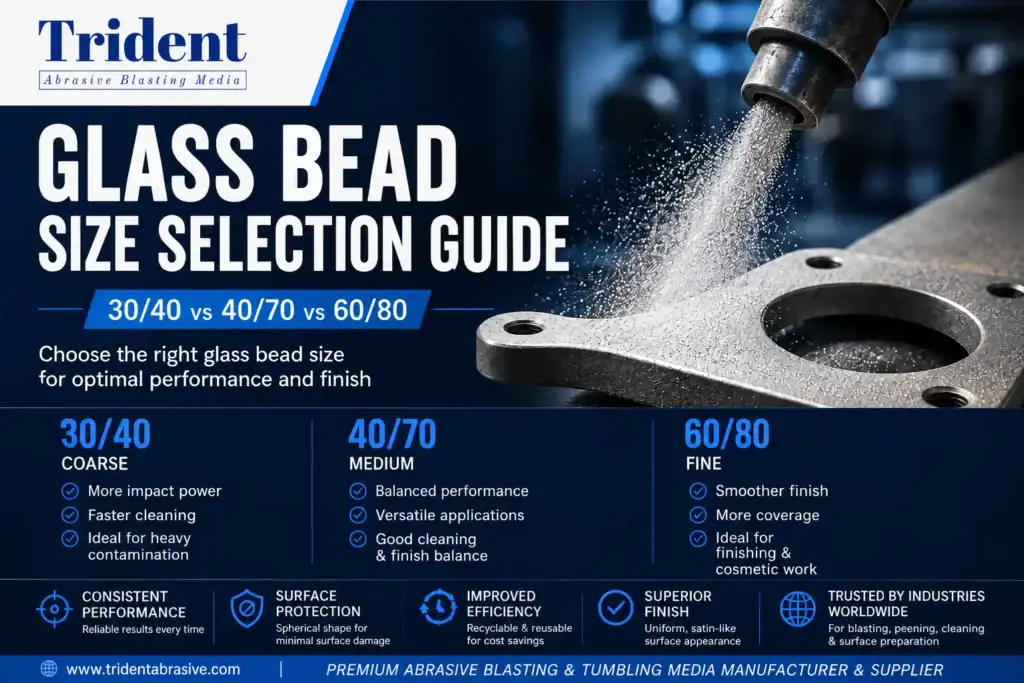
Selecting the right glass bead size can make a significant difference in abrasive blasting performance.
The correct glass bead grade can influence cleaning efficiency, surface appearance, media consumption, equipment performance, and the consistency of the finished component.
Among the commonly discussed grades, 30/40, 40/70, and 60/80 represent different particle-size ranges and can produce different blasting characteristics.
But choosing the right glass bead isn’t simply a matter of selecting the largest or smallest particle.
The right choice depends on:
- The material being blasted
- The desired surface finish
- The level of contamination or oxidation
- Blast pressure
- Nozzle configuration
- Blast distance
- Media flow
- Equipment design
- Required production rate
- Media condition and particle-size consistency
This guide explains the practical differences between 30/40, 40/70, and 60/80 and how industrial users can approach selection.
What Are Glass Beads Used For?
Glass beads are spherical abrasive blasting media manufactured from glass and used in applications where controlled cleaning and finishing are required.
Unlike angular abrasives such as aluminum oxide and crushed glass, glass beads have a rounded particle shape.
This spherical geometry makes them particularly useful for applications involving:
- Surface cleaning
- Finishing
- Deburring
- Surface conditioning
- Peening
- Cosmetic blasting
- Preparation before subsequent finishing
- Cleaning industrial components
Glass beads can be used on a range of substrates, including stainless steel, aluminum, glass, plastics, and other industrial materials.
The objective is generally not simply to remove as much material as possible. Instead, glass beads are often selected when the user wants a controlled blasting process with a more refined surface appearance.
Understanding Glass Bead Mesh Sizes
Before comparing 30/40, 40/70, and 60/80, it is important to understand what the numbers represent.
Glass beads are commonly classified according to mesh or sieve-size designations.
As a general rule:
| Grade | Relative Size | General Character |
|---|---|---|
| 30/40 | Coarser | Higher individual particle impact |
| 40/70 | Medium | Balanced blasting characteristics |
| 60/80 | Finer | Greater finish control |
In general, 30/40 is coarser than 40/70, while 60/80 is finer.
However, mesh designations should not be treated as a complete technical specification.
Particle-size distributions can vary between suppliers, so industrial buyers should request technical documentation such as sieve analysis and particle-size distribution when consistency is important.
At Trident Abrasive, glass bead grades are available across a broader range of particle sizes depending on the intended application.
30/40 Glass Beads: Coarser Blasting Media
30/40 glass beads represent a relatively coarse glass bead grade.
Because the particles are larger, they can provide a stronger individual impact under comparable blasting conditions.
This can make 30/40 worth considering for applications where the blasting process requires a relatively coarse spherical media while retaining the characteristics associated with glass beads.
Potential applications for 30/40
Depending on the substrate and blasting parameters, 30/40 may be considered for:
- General industrial cleaning
- Surface preparation
- Cleaning robust components
- Maintenance and restoration
- Certain peening applications
- Removal of light-to-moderate contamination
- Applications where a coarser spherical abrasive is specified
However, coarser does not automatically mean better or faster.
The correct grade depends on the material, equipment, contamination, desired finish, and operating parameters.
When should you consider 30/40?
30/40 may be worth testing when:
- The component can tolerate a coarser blasting action.
- A relatively strong individual particle impact is desired.
- General cleaning is the primary objective.
- The application calls for a coarse spherical abrasive.
- Surface appearance does not require the finer control associated with smaller beads.
For delicate components or applications requiring a refined cosmetic finish, a finer grade may be more appropriate.
40/70 Glass Beads: A Balanced Option
40/70 glass beads sit between the coarser 30/40 grade and finer grades such as 60/80.
For many blasting operations, an intermediate particle size can provide a useful balance between cleaning performance and surface-finish control.
This makes 40/70 an option worth evaluating for general-purpose industrial blasting.
Potential applications for 40/70
Depending on the blasting process, 40/70 may be considered for:
- Stainless steel cleaning
- Aluminum finishing
- General metal cleaning
- Cosmetic surface preparation
- Light oxidation removal
- Surface conditioning
- Preparation before additional finishing
- General-purpose bead blasting
The exact result will depend on the blasting equipment and process settings.
Why particle-size consistency matters
Two abrasive products carrying similar mesh designations can behave differently if their particle-size distributions are different.
For critical applications, industrial buyers should consider requesting:
- Sieve analysis
- Particle-size distribution
- Bulk density
- Specific gravity
- Hardness
- Bead roundness
- Chemical composition
- Certificate of Analysis
- SDS
Technical consistency is especially important when the abrasive is being used in repeat production.
60/80 Glass Beads: Finer Surface-Finish Control
60/80 glass beads are finer than both 30/40 and 40/70.
Finer glass bead media can be useful when the objective is greater control over the finished appearance rather than relying on a coarser particle impact.
Potential applications for 60/80
60/80 may be considered for:
- Stainless steel finishing
- Aluminum finishing
- Cosmetic blasting
- Light cleaning
- Surface conditioning
- Precision-component cleaning
- Certain deburring applications
- Satin finishing
When should you consider 60/80?
A finer grade such as 60/80 may be worth testing when:
- Surface appearance is important.
- A finer blasting media is required.
- The cleaning requirement is relatively light to moderate.
- A controlled finish is desired.
- The component is comparatively sensitive to aggressive blasting.
As with every abrasive application, testing the actual component is recommended before standardizing a production grade.
30/40 vs 40/70 vs 60/80 Glass Beads
Here is a simple starting point for comparing the three grades:
| Glass Bead Grade | Relative Particle Size | General Character | Potential Applications |
| 30/40 | Coarse | Stronger individual impact | General cleaning, robust components |
| 40/70 | Medium | Balanced performance | General-purpose blasting |
| 60/80 | Fine | Greater finish control | Finishing, cosmetic blasting, light cleaning |
Think of the grades as different process tools:
30/40 → Coarser impact
40/70 → Balanced performance
60/80 → Finer control
This is a useful starting framework, but the final choice should always be validated against the actual component and blasting system.
How Glass Bead Size Influences Surface Finish
One of the biggest reasons manufacturers change glass bead sizes is to achieve a different surface appearance.
Glass beads are spherical, which gives them different blasting characteristics compared with angular abrasives.
For example:
Glass beads → spherical particle geometry → controlled cleaning and finishing
Crushed glass → angular particle geometry → more aggressive cutting and surface preparation
Aluminum oxide → angular, hard abrasive → aggressive cleaning and profiling
Therefore, selecting glass beads is not simply about particle size. The shape, hardness, density, equipment settings, and surface condition also influence the final result.
10 Factors That Affect Your Final Blasting Result
Even if two companies use the same glass bead grade, their results may be different.
The final surface condition can be influenced by:
- Glass bead size
- Particle-size distribution
- Air pressure
- Nozzle size
- Blast distance
- Blast angle
- Exposure time
- Media flow rate
- Substrate material
- Media condition
This is why abrasive selection should be considered together with the entire blasting process.
How to Select the Right Glass Bead Size
1. Start With the Substrate
The material being blasted should be one of the first considerations.
Aluminum, stainless steel, carbon steel, and other alloys respond differently to abrasive impact.
A glass bead grade that performs well on a robust steel component may not be the right choice for a thin aluminum component.
Whenever possible, test the selected grade on the actual material before moving into production.
2. Identify What You Need to Remove
Ask a simple question:
What are you trying to remove or change?
The answer can significantly influence abrasive selection.
Common contaminants include:
- Dirt
- Oxidation
- Light rust
- Paint residue
- Oil and grease
- Manufacturing residue
- Scale
- Surface contamination
Glass beads are not necessarily the ideal choice for every heavy coating-removal application.
If aggressive coating removal or deeper surface profiling is required, an angular abrasive such as aluminum oxide or crushed glass may be more appropriate.
3. Define the Desired Finish
Before selecting the abrasive, define what the component should look like after blasting.
Are you looking for:
- Cleaning?
- A uniform satin appearance?
- Cosmetic finishing?
- Surface conditioning?
- Deburring?
- Peening?
- Aggressive coating removal?
The desired end result should drive abrasive selection.
Choosing a media solely because it is cheaper can result in higher overall process costs if the media does not deliver the required finish.
4. Evaluate Your Equipment
Your blasting machine also influences which glass bead grade will perform best.
Consider:
- Compressor capacity
- Blast pressure
- Nozzle size
- Media flow
- Cabinet or blast-room configuration
- Reclaim system
- Part geometry
- Operator technique
A change in glass bead size may require adjustments to the blasting parameters.
Does a Larger Glass Bead Blast Faster?
Not necessarily.
A common assumption is:
Larger abrasive = faster blasting.
That is not always true.
Production performance depends on the entire blasting system.
Important factors include:
- Compressor capacity
- Blast pressure
- Nozzle size
- Media flow
- Part geometry
- Equipment design
- Contamination
- Operator technique
- Media condition
Therefore, the better question is:
Which glass bead grade produces the required result at the lowest total process cost?
That is a much more useful question for industrial purchasing and production teams.
Glass Bead Size and Media Consumption
Media consumption is another important factor when evaluating abrasive blasting performance.
Consumption can depend on:
- Blasting pressure
- Blast time
- Media flow rate
- Surface contamination
- Part geometry
- Equipment efficiency
- Reclaim efficiency
- Media breakdown
- Desired finish
Glass beads can be reused in suitable blasting systems, particularly in controlled cabinet and reclaim applications.
However, actual media life will depend on operating conditions, equipment, contamination, and the condition of the abrasive.
For this reason, manufacturers should evaluate cost per finished component, rather than simply comparing the price per bag of abrasive.
Why Particle-Size Distribution Matters
Mesh size alone does not tell the entire story.
Two products with the same general mesh designation can potentially perform differently if their particle-size distributions are different.
A consistent particle-size distribution can help provide more predictable blasting results.
For industrial applications, ask your abrasive supplier for technical information such as:
- Sieve analysis
- Particle-size distribution
- Bulk density
- Specific gravity
- Hardness
- Roundness/sphericity
- Chemical composition
- Certificate of Analysis
- SDS
This allows purchasing and production teams to compare abrasive media based on technical performance and consistency, rather than price alone.
Glass Beads vs Other Abrasive Media
Glass beads are one part of a much larger abrasive-media category.
Different abrasive materials are designed for different blasting objectives.
| Abrasive Media | Particle Shape | General Application |
| Glass Beads | Spherical | Cleaning, finishing, peening |
| Crushed Glass | Angular | Coating removal, surface preparation |
| Aluminum Oxide | Angular | Aggressive cleaning and profiling |
| Steel Shot | Spherical | Cleaning and peening |
| Steel Grit | Angular | Heavy-duty cleaning and profiling |
| Garnet | Sub-angular | Surface preparation and cutting |
The goal is not to find one abrasive that works for everything.
The goal is to select the abrasive that matches the substrate, contamination, finish requirement, equipment, and production objective.
Frequently Asked Questions
Is 30/40 glass bead coarser than 60/80?
Yes.
30/40 represents a coarser glass bead grade, while 60/80 represents a finer grade.
What is 40/70 glass bead used for?
40/70 can be considered an intermediate glass bead grade for applications requiring a balance between cleaning capability and surface-finish control.
The exact application depends on the supplier’s particle-size specification and the blasting process.
What is 60/80 glass bead used for?
60/80 can be considered for finer cleaning and surface-finishing applications where controlled surface appearance is important.
Which glass bead size is best for aluminum?
There is no single glass bead size that is universally best for aluminum.
The appropriate grade depends on:
- Aluminum alloy
- Component thickness
- Desired finish
- Blast pressure
- Nozzle configuration
- Blast distance
- Equipment
Testing the selected grade on the actual component is the safest approach before production standardization.
Which glass bead size gives the smoothest finish?
Finer glass bead grades can provide greater control over surface appearance, but particle size is only one factor.
Pressure, nozzle configuration, blast distance, exposure time, substrate, and media condition can all influence the final finish.
Can different glass bead sizes be used in the same blasting machine?
A blasting machine may be capable of using different glass bead grades.
However, changing grades requires consideration of equipment settings and reclaim systems.
Different grades should not simply be mixed when a controlled particle-size distribution is required.
Why Choose Trident Abrasive for Glass Beads?
At Trident Abrasive, we focus on supplying abrasive media for industrial blasting, surface preparation, cleaning, finishing, deburring, and related applications.
Our abrasive-media portfolio includes:
- Glass Beads
- Aluminum Oxide
- Crushed Glass
- Steel Shot
- Steel Grit
- Garnet
- Ceramic Media
- Plastic Media
- Walnut Shell Media
- Other blasting and finishing media
Our goal is to help industrial users select abrasive media based on application requirements, technical specifications, consistency, and overall process performance.
For buyers evaluating glass beads, we recommend looking beyond the mesh designation and considering particle-size distribution, roundness, density, hardness, cleanliness, documentation, packaging, availability, and application requirements.
Final Takeaway: 30/40 vs 40/70 vs 60/80
There is no universal “best” glass bead size.
Instead, think about the grades this way:
30/40
Coarser impact
A starting point for applications where a relatively coarse spherical abrasive is required.
40/70
Balanced performance
An intermediate option worth evaluating for general-purpose blasting and applications requiring a balance between cleaning and finishing.
60/80
Finer control
A finer option worth considering when surface appearance and controlled finishing are important.
Ultimately, the best glass bead is the one that delivers the required result while maintaining:
Surface quality + productivity + substrate integrity + predictable media consumption + acceptable total operating cost
Get the Right Glass Bead for Your Application
Selecting abrasive media can be challenging when you’re comparing multiple particle sizes and specifications.
If you’re evaluating 30/40, 40/70, 60/80, or other glass bead grades, compare the technical specifications and test the media on your actual component before standardizing your production process.
Explore Trident Abrasive Glass Beads and Industrial Abrasive Media: https://tridentabrasive.com/abrasive-sandblasting-media/
Visit Trident Abrasive: https://tridentabrasive.com/
Abrasive Blasting Safety
Abrasive blasting can generate dust and noise, and the hazards associated with blasting depend on both the abrasive material and the substance being removed from the workpiece.
Blasting operations should be performed using appropriate engineering controls, ventilation, respiratory protection, personal protective equipment, and safe operating procedures.
Always follow the applicable workplace regulations, equipment manufacturer’s instructions, Safety Data Sheet (SDS), and site-specific safety requirements.
For U.S. operations, consult the applicable OSHA abrasive-blasting requirements and guidance.
About Trident Abrasive
Trident Abrasive supplies industrial abrasive blasting and finishing media for applications including surface cleaning, preparation, finishing, deburring, and peening.
Our objective is simple: help industrial users select the right abrasive for the job.
Please check OSHA site for more safety information : OSHA – Protecting Workers from the Hazards of Abrasive Blasting Materials
You can also visit our product page for more information .