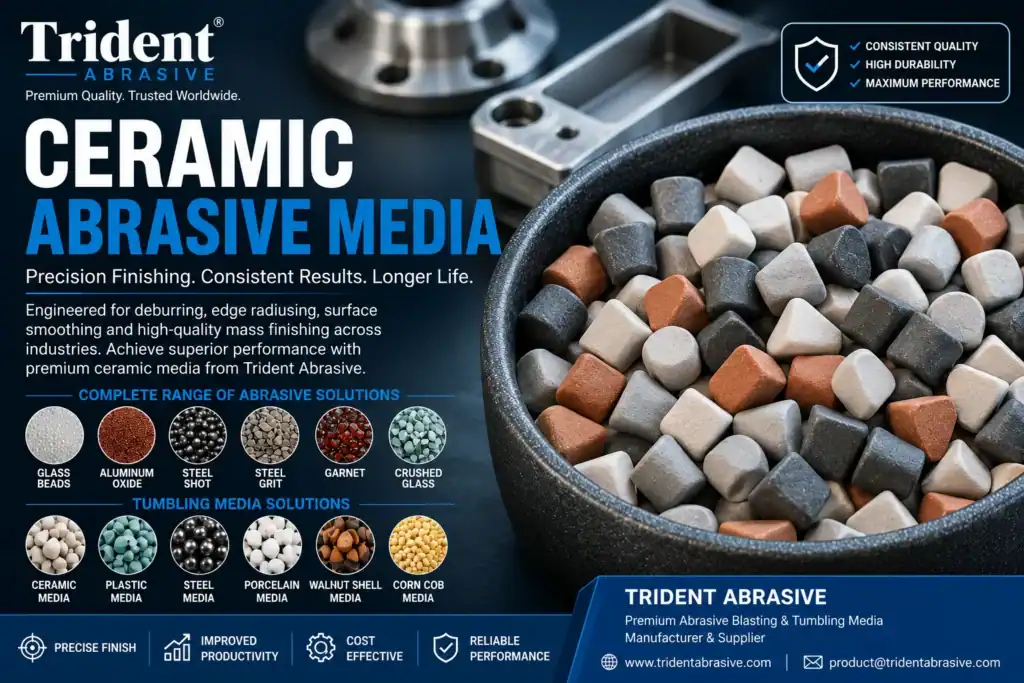
When manufacturers need a dependable solution for deburring, edge radiusing, polishing, burnishing, cleaning, and surface preparation, ceramic abrasive media is one of the most trusted choices across industries. From aerospace and automotive to medical devices and precision engineering, ceramic media delivers consistent, repeatable, and high-quality finishes while maintaining excellent durability over thousands of finishing cycles.
Unlike blasting media that is propelled at high velocity to clean or prepare surfaces, ceramic abrasive media is primarily designed for mass finishing processes such as vibratory finishing, centrifugal barrel finishing, drag finishing, and rotary tumbling. Its combination of hardness, cutting ability, and long service life makes it an excellent investment for manufacturers seeking efficiency and consistent quality.
At Trident Abrasive, we supply premium ceramic abrasive media engineered for industrial applications where precision, productivity, and durability are essential. Whether you’re finishing stainless steel, aluminum, brass, titanium, hardened steel, or other alloys, selecting the correct ceramic media can significantly improve production quality while reducing overall operating costs.
This comprehensive guide explores everything you need to know about ceramic abrasive media, including its composition, advantages, applications, comparison with other tumbling and blasting media, selection criteria, maintenance tips, and industry best practices.
What Is Ceramic Abrasive Media?
Ceramic abrasive media is a manufactured finishing media composed primarily of:
- High-grade ceramic binders
- Aluminum oxide abrasives
- Silica-based compounds
- Proprietary bonding materials
These materials are fired at extremely high temperatures to create a dense, hard, wear-resistant finishing media capable of maintaining its cutting characteristics throughout an extended service life.
Unlike natural abrasives, ceramic media is engineered with controlled density, hardness, and geometry, ensuring uniform finishing performance across every production batch.
Because of its controlled manufacturing process, ceramic media provides:
- Consistent cutting action
- Predictable finishing results
- Excellent dimensional stability
- Long operational life
- Reduced process variability
How Ceramic Abrasive Media Works
Ceramic media removes material through controlled abrasion during a mass finishing process.
As parts and media rotate or vibrate together, thousands of microscopic cutting actions occur simultaneously.
The process accomplishes:
- Burr removal
- Edge rounding
- Surface smoothing
- Scale removal
- Oxide cleaning
- Surface refinement
- Pre-polishing preparation
Unlike aggressive grinding, ceramic media removes only small amounts of material in a highly controlled manner, preserving part geometry while improving surface quality.
Types of Ceramic Abrasive Media
Manufacturers produce ceramic media in numerous shapes because different geometries access different part features.
Common shapes include:
Cylinders
Excellent for:
- Flat surfaces
- General deburring
- Medium to heavy cutting
Triangles
Ideal for:
- Corners
- Slots
- Complex geometries
Angle Cuts
Designed for:
- Intricate machined components
- Internal features
- Recessed surfaces
Spheres
Best for:
- Burnishing
- Gentle polishing
- Uniform surface finishing
Wedges
Excellent for:
- Tight corners
- Precision deburring
- Complex aerospace components
Cones
Preferred when finishing:
- Deep recesses
- Blind holes
- Complex castings
Selecting the correct shape is just as important as selecting the correct abrasive grade.
Key Properties of Ceramic Media
Premium ceramic abrasive media offers several important physical characteristics.
High Density
The higher density provides:
- Faster cutting
- Greater deburring capability
- Improved finishing efficiency
Excellent Hardness
Ceramic media typically exhibits hardness significantly higher than plastic media, enabling it to process:
- Hardened steel
- Stainless steel
- Tool steel
- Titanium
- Nickel alloys
Long Service Life
Compared to many alternative media, ceramic media wears slowly, making it highly economical over long production runs.
Consistent Performance
Uniform manufacturing ensures:
- Stable cutting rates
- Consistent surface finish
- Reliable production quality
Advantages of Ceramic Abrasive Media
Manufacturers worldwide choose ceramic media because it offers an outstanding balance of cutting performance and longevity.
Major advantages include:
- Fast material removal
- Superior deburring
- Excellent edge radiusing
- High durability
- Reduced media replacement costs
- Uniform surface finishes
- Compatible with automated finishing systems
- Excellent for high-volume production
- Performs well with difficult alloys
For many industrial operations, ceramic media delivers a lower total cost of ownership than softer finishing media due to its extended lifespan.
Applications Across Industries
Ceramic abrasive media is used in virtually every manufacturing sector.
Automotive
Applications include:
- Engine components
- Transmission parts
- Brake components
- Fuel system parts
- Suspension hardware
Aerospace
Used for:
- Turbine components
- Titanium parts
- Landing gear components
- Precision machined parts
- Structural fasteners
Medical Manufacturing
Ideal for:
- Surgical instruments
- Orthopedic implants
- Stainless steel devices
- Dental components
Metal Fabrication
Perfect for:
- Laser-cut parts
- Waterjet-cut parts
- CNC machined components
- Weld preparation
- Sheet metal finishing
Jewelry Manufacturing
Used for:
- Precious metals
- Fine polishing preparation
- Surface refinement
Ceramic Abrasive Media vs. Other Tumbling Media
Selecting the right tumbling media is one of the most important decisions in any mass finishing operation. Each type of media offers unique characteristics that influence cutting speed, surface finish, media longevity, and overall operating cost.
Understanding these differences helps manufacturers optimize productivity while achieving the desired surface quality.
Ceramic Media vs. Plastic Media
Ceramic and plastic media are among the most widely used finishing media, but they serve different purposes.
| Ceramic Media | Plastic Media |
|---|---|
| Aggressive cutting action | Light to moderate cutting |
| High density | Lower density |
| Excellent for steel and hard alloys | Ideal for aluminum, brass, and soft metals |
| Longer service life | Faster wear rate |
| Heavy burr removal | Fine finishing and polishing |
Plastic media is often preferred when delicate components require minimal material removal, while ceramic media is chosen for demanding industrial deburring and edge radiusing.
For example, aerospace aluminum components often benefit from plastic media to preserve tight tolerances, whereas hardened steel gears require ceramic media for efficient burr removal.
Ceramic Media vs. Steel Tumbling Media
Steel media performs very differently than ceramic media.
Steel media primarily burnishes rather than cuts.
Ceramic Media
- Removes burrs
- Smooths surfaces
- Cuts material
- Rounds edges
- Prepares surfaces
Steel Media
- Compresses surfaces
- Produces bright finishes
- Work-hardens components
- Creates mirror-like appearances
Many manufacturers use ceramic media first for deburring and then switch to steel media for final burnishing.
Ceramic Media vs. Porcelain Media
Porcelain media contains little or no abrasive.
Its primary function is:
- Cleaning
- Burnishing
- Surface smoothing
- Gentle polishing
Ceramic media is significantly more aggressive and removes material much faster.
Ceramic Abrasive Media vs. Blasting Media
Although both remove unwanted material, blasting media and tumbling media work in completely different ways.
Ceramic Tumbling Media
Works by:
- Controlled rubbing action
- Continuous contact
- Mass finishing
- Vibratory motion
- Barrel rotation
Best for:
- Deburring
- Edge radiusing
- Surface refinement
- Precision finishing
Blasting Media
Blasting media works by impacting the surface at high velocity.
Examples include:
- Glass Beads
- Aluminum Oxide
- Garnet
- Steel Shot
- Steel Grit
- Crushed Glass
- Walnut Shell
- Corn Cob
These materials are propelled using compressed air or centrifugal wheels.
Blasting is ideal for:
- Rust removal
- Paint stripping
- Scale removal
- Surface preparation
- Cleaning welds
- Anchor profile creation
Unlike tumbling, blasting usually processes one surface at a time rather than the entire component simultaneously.
Comparison with Popular Blasting Media
Understanding when to choose ceramic tumbling media versus blasting media can dramatically improve manufacturing efficiency.
Glass Beads
Glass bead blasting creates a smooth satin finish without significantly changing part dimensions.
Best for:
- Stainless steel
- Aluminum
- Aerospace components
- Medical equipment
- Cosmetic finishing
Unlike ceramic media, glass beads do not aggressively remove burrs.
Many manufacturers first deburr using ceramic media and then blast with glass beads for a uniform cosmetic finish.
Aluminum Oxide
Aluminum oxide is one of the hardest blasting abrasives available.
Ideal for:
- Heavy rust
- Mill scale
- Surface preparation
- Coating removal
Compared with ceramic tumbling media:
| Ceramic Media | Aluminum Oxide |
|---|---|
| Mass finishing | Abrasive blasting |
| Controlled cutting | Aggressive impact |
| Deburring | Surface preparation |
| Long reuse cycles | Reusable blasting abrasive |
Garnet
Garnet is a natural mineral abrasive commonly used for:
- Sandblasting
- Waterjet cutting
- Surface preparation
Advantages include:
- Low dust
- Excellent cutting
- Environmentally friendly
- Low free silica
Unlike ceramic media, garnet is not used for vibratory finishing.
Steel Shot
Steel shot produces:
- Peening
- Cleaning
- Surface strengthening
- Scale removal
It is commonly used in:
- Automotive manufacturing
- Foundries
- Heavy equipment
Steel shot blasting improves fatigue resistance through compressive surface stresses, whereas ceramic media focuses on finishing precision.
Steel Grit
Steel grit has angular particles that aggressively remove:
- Rust
- Paint
- Heavy scale
Applications include:
- Shipbuilding
- Structural steel
- Bridge maintenance
- Heavy fabrication
It is significantly more aggressive than ceramic finishing media.
Crushed Glass
Crushed glass has become increasingly popular because it offers:
- Fast cleaning
- Low free silica
- Environmentally responsible disposal
- Good surface profiles
It is frequently used for:
- Marine restoration
- Industrial maintenance
- Concrete cleaning
- Steel preparation
Walnut Shell Media
Walnut shell is one of the gentlest blasting abrasives.
Ideal for:
- Aircraft restoration
- Composite materials
- Wood
- Soft metals
- Historic restoration
It cleans surfaces without damaging the substrate.
Unlike ceramic media, walnut shell performs virtually no deburring.
Choosing the Right Ceramic Media
Selecting the ideal ceramic media requires evaluating several important factors.
1. Material Type
Hard metals generally require harder ceramic formulations.
Examples:
- Stainless steel
- Tool steel
- Titanium
- Nickel alloys
Soft metals often benefit from lighter cutting media.
2. Part Geometry
Complex parts may require:
- Angle cuts
- Triangles
- Wedges
- Cones
Simple components often perform well with cylinders or spheres.
3. Required Finish
Determine whether your goal is:
- Heavy deburring
- Edge radiusing
- Surface smoothing
- Pre-polishing
- Fine finishing
Different ceramic formulations are optimized for different objectives.
4. Machine Type
Ceramic media performs differently in:
- Vibratory finishers
- Rotary barrels
- Centrifugal barrels
- Drag finishing systems
- Disc finishing machines
Selecting media specifically designed for your equipment improves consistency.
Best Practices for Maximum Performance
To maximize media life and finishing quality:
✔ Use the correct compound.
✔ Maintain proper water flow.
✔ Separate worn media regularly.
✔ Avoid overloading equipment.
✔ Match media size to part size.
✔ Clean equipment routinely.
✔ Replace media gradually instead of all at once.
These practices reduce operating costs while maintaining consistent results.
Why Manufacturers Choose Trident Abrasive
At Trident Abrasive, we understand that every finishing process is unique. Our ceramic abrasive media is engineered to deliver reliable performance across a wide range of industrial applications.
We offer:
- Premium-quality ceramic tumbling media
- Multiple shapes and abrasive grades
- Consistent density and hardness
- Long service life for reduced operating costs
- Solutions for vibratory, centrifugal, and rotary finishing systems
- Technical support to help customers select the right media
Beyond ceramic media, Trident Abrasive supplies a comprehensive portfolio of abrasive blasting and mass finishing products, including:
- Glass Beads
- Brown Aluminum Oxide
- White Aluminum Oxide
- Steel Shot
- Steel Grit
- Garnet
- Crushed Glass
- Plastic Tumbling Media
- Steel Tumbling Media
- Porcelain Media
- Walnut Shell Media
- Corn Cob Media
By offering both blasting media and tumbling media, we help manufacturers source complete surface preparation and finishing solutions from a single trusted supplier.
Conclusion
Ceramic abrasive media remains one of the most versatile and effective solutions for industrial deburring, edge radiusing, and precision surface finishing. Its exceptional durability, controlled cutting action, and compatibility with a wide variety of metals make it indispensable in industries where consistency and quality are paramount.
When combined with the right finishing compounds, properly selected media shapes, and optimized processing parameters, ceramic media can significantly improve productivity while lowering overall finishing costs.
Whether your application involves aerospace components, automotive parts, medical instruments, or precision-machined components, investing in high-quality ceramic media ensures repeatable, professional results.
Trident Abrasive is committed to providing premium abrasive solutions backed by technical expertise and reliable service. Whether you need ceramic tumbling media for mass finishing or abrasive blasting media such as glass beads, aluminum oxide, garnet, steel shot, steel grit, or crushed glass, our team can help you select the ideal product for your process.
Frequently Asked Questions (FAQs)
1. What is ceramic abrasive media used for?
Ceramic abrasive media is used for deburring, edge radiusing, surface smoothing, cleaning, and polishing metal components in vibratory, rotary, and centrifugal finishing systems.
2. Is ceramic media reusable?
Yes. High-quality ceramic media is designed for extended reuse and offers excellent wear resistance.
3. Can ceramic media be used on aluminum?
Yes, but softer ceramic grades or plastic media may be preferred for thin or delicate aluminum parts.
4. What industries use ceramic media?
Automotive, aerospace, medical device manufacturing, machining, metal fabrication, jewelry, and precision engineering.
5. How long does ceramic media last?
Its lifespan depends on the application, machine type, and workload, but ceramic media generally lasts much longer than plastic media.
6. Does ceramic media polish parts?
It can produce a smooth finish, but mirror polishing typically requires a secondary polishing or burnishing stage.
7. What machine works best with ceramic media?
Vibratory finishers are the most common, though ceramic media is also suitable for rotary barrels, centrifugal barrels, and drag finishing systems.
8. How do I choose the right media shape?
Select shapes based on part geometry. Triangles and cones reach tight areas, while cylinders and spheres suit simpler components.
9. Can ceramic media remove rust?
Light oxidation may be removed, but heavy rust is generally better addressed with abrasive blasting media such as aluminum oxide or steel grit.
10. Why choose Trident Abrasive?
Trident Abrasive provides premium-quality tumbling and blasting media, technical guidance, consistent product quality, and solutions tailored to demanding industrial applications.
Industry publication covering mass finishing media, compounds, and equipment.
Mass Finishing Media and Compounds