A Complete Guide of Glass Bead Manufacturers Comparison
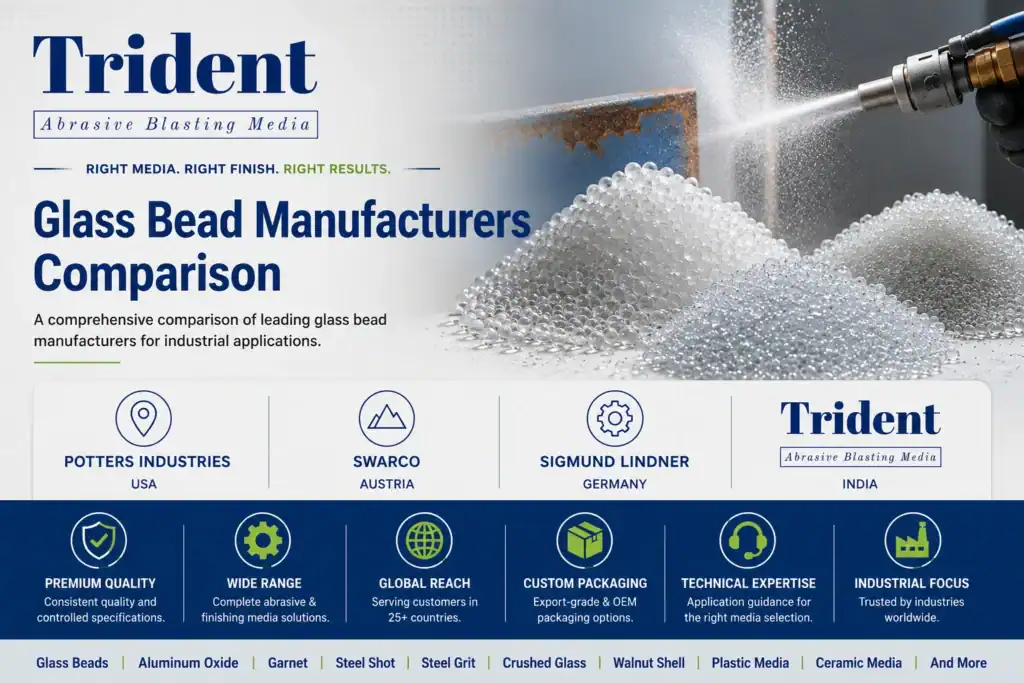
Selecting the right glass bead supplier involves much more than comparing prices. Manufacturers differ in product specialization, production scale, geographic reach, customization capabilities, packaging options, and technical support.
This glass bead manufactures comparison guide provides a neutral overview of four well-known companies that manufacture industrial glass beads:
- Potters Industries (USA)
- SWARCO (Austria)
- Sigmund Lindner (Germany)
- Trident Abrasive (India)
Each company has built expertise in different market segments, making them suitable for different industrial requirements.
Why Comparing Glass Bead Manufacturers Matters
Industrial glass beads are widely used in abrasive blasting, shot peening, surface preparation, and precision finishing applications across manufacturing, aerospace, automotive, marine, metal fabrication, and restoration industries. Although glass beads may appear similar at first glance, manufacturers can differ significantly in production capabilities, quality control processes, product range, technical support, and the industries they primarily serve. As a result, selecting the right supplier involves evaluating several factors beyond the initial purchase price.
For many industrial buyers, consistency is one of the most important considerations. Uniform bead size, controlled hardness, and low contamination levels can contribute to repeatable blasting results, improved surface finishes, and longer media life. Depending on the application, buyers may also require specific particle size distributions, compliance with industry standards, or customized packaging to support production efficiency and logistics.
Another important factor is the breadth of a manufacturer’s product portfolio. Some companies specialize exclusively in glass bead production, while others provide a wider range of abrasive blasting media and surface finishing solutions. Businesses that use multiple blasting materials—such as aluminum oxide, garnet, steel shot, steel grit, crushed glass, ceramic media, or plastic media—may benefit from working with a supplier capable of providing several products through a single supply chain. This can simplify procurement, improve inventory management, and ensure greater compatibility between different blasting processes.
Geographic reach and export capabilities are also valuable considerations, particularly for international distributors and manufacturers. Reliable global shipping, export-grade packaging, consistent product availability, and responsive customer support can help reduce downtime and improve supply chain stability. Companies serving customers across multiple regions often develop packaging and logistics solutions designed to protect abrasive media during transportation and storage.
Technical support is another differentiating factor. Many industrial projects require guidance on selecting the appropriate blasting media, optimizing blasting parameters, achieving the desired surface profile, or balancing cleaning performance with surface preservation. Manufacturers that provide technical recommendations, application guidance, and product selection assistance can help customers improve productivity while reducing unnecessary media consumption and equipment wear.
It is also worth recognizing that no single manufacturer is designed to meet every industrial requirement. Some companies have decades of experience in engineered glass materials and precision applications, while others focus on transportation infrastructure, specialty glass products, or comprehensive abrasive media solutions. Each has developed expertise within its respective market segment and serves different customer needs.
The purpose of this comparison is not to identify a single “best” manufacturer, but to provide an objective overview of four established companies operating in the industrial glass bead market. By understanding their areas of focus, product portfolios, and general capabilities, buyers can make more informed purchasing decisions based on their specific applications, operational requirements, and long-term business objectives.
Company Overview
| Company | Headquarters | Primary Focus |
|---|---|---|
| Potters Industries | United States | Industrial glass beads, highway safety products, engineered materials |
| SWARCO | Austria | Road marking systems, reflective glass beads, industrial glass beads |
| Sigmund Lindner | Germany | Precision glass beads, technical glass products, pharmaceutical applications |
| Trident Abrasive | India | Abrasive blasting media, tumbling media, industrial finishing solutions |
Manufacturing Focus
While all four companies manufacture glass beads, their broader product portfolios differ.
| Company | Primary Business |
|---|---|
| Potters Industries | Industrial glass beads and engineered materials |
| SWARCO | Transportation infrastructure and glass technology |
| Sigmund Lindner | Precision glass technology and specialty materials |
| Trident Abrasive | Abrasive blasting and surface finishing media |
Trident’s catalog extends beyond glass beads to include aluminum oxide, garnet, steel shot, steel grit, crushed glass, walnut shell, ceramic media, plastic media, tumbling media, sandpaper, and buffing products, allowing customers to source multiple abrasive products from a single supplier.
Glass Bead Applications
All four manufacturers supply glass beads for industrial applications, including:
- Deburring
- Shot peening
- Cosmetic finishing
- Non-destructive cleaning
- Surface preparation
- Surface cleaning
Application suitability depends on bead size, hardness, blasting equipment, and process parameters rather than the manufacturer alone.
Product Portfolio Comparison
| Feature | Potters | SWARCO | Sigmund Lindner | Trident Abrasive |
|---|---|---|---|---|
| Glass Beads | ✓ | ✓ | ✓ | ✓ |
| Aluminum Oxide | — | — | Limited | ✓ |
| Garnet | — | — | — | ✓ |
| Steel Shot | — | — | — | ✓ |
| Steel Grit | — | — | — | ✓ |
| Crushed Glass | — | — | — | ✓ |
| Walnut Shell | — | — | — | ✓ |
| Plastic Media | — | — | — | ✓ |
| Ceramic Media | — | — | — | ✓ |
Product offerings evolve over time. Buyers should confirm current availability with each manufacturer.
Technical Support
Industrial buyers often evaluate suppliers on the technical assistance provided before selecting blasting media.
Typical support may include:
- Media selection guidance
- Recommended blasting parameters
- Surface profile recommendations
- Packaging options
- Application-specific advice
According to its product literature, Trident provides application guidance, media selection recommendations, and compatibility guidance for different blasting systems and finishing processes.
Packaging Options
Packaging can be an important factor for distributors and industrial users.
| Company | Standard Industrial Packaging | Custom Packaging |
|---|---|---|
| Potters Industries | Yes | Varies |
| SWARCO | Yes | Varies |
| Sigmund Lindner | Yes | Varies |
| Trident Abrasive | Yes | Yes |
Trident states that it offers HDPE bags, paper bags, plastic buckets, and customized packaging options including private labeling for industrial and export customers.
Industries Served
Glass bead blasting is used across numerous industries.
Common sectors include:
- Aerospace
- Automotive
- General manufacturing
- Marine
- Metal fabrication
- Restoration
- Construction
Trident’s catalog specifically highlights these industries as target applications for its abrasive solutions.
Choosing the Right Supplier
The most suitable supplier depends on your project requirements.
Potters Industries
Often considered for organizations seeking industrial glass bead solutions supported by a long-established international manufacturer.
SWARCO
Known primarily for expertise in glass technology and transportation infrastructure, while also serving industrial glass bead markets.
Sigmund Lindner
Well known for precision glass products used in industrial, technical, and specialty applications.
Trident Abrasive
Suitable for buyers looking for a broader abrasive media supplier that offers multiple blasting and finishing products alongside glass beads, technical application guidance, and export-oriented packaging. According to its brochure, Trident manufactures abrasive media, operates a manufacturing facility in Ahmedabad, India, and supports global sourcing and export-grade packaging.
Beyond Glass Beads: Trident Abrasive’s Broader Product Portfolio
While this comparison focuses on industrial glass beads, many manufacturers also offer additional products that support surface preparation and finishing operations. Buyers that require multiple abrasive solutions often prefer working with suppliers capable of providing a wider range of compatible products through a single procurement channel.
Trident Abrasive positions itself as a manufacturer and supplier of industrial abrasive and finishing solutions rather than focusing solely on glass beads. In addition to abrasive glass beads, its portfolio includes aluminum oxide, garnet, steel shot, steel grit, crushed glass, ceramic tumbling media, plastic tumbling media, walnut shell media, sanding discs, sandpaper, and buffing wheels for a variety of industrial applications. The company states that these products are designed for surface preparation, rust and coating removal, deburring, shot peening, polishing, waterjet cutting, and precision finishing across industries such as aerospace, automotive, marine, metal fabrication, construction, and general manufacturing.
For manufacturers, distributors, and OEM customers, sourcing multiple abrasive products from a single supplier can simplify purchasing, improve inventory management, and help ensure consistency across different finishing processes. Trident also highlights technical media selection assistance, export-grade packaging, and custom packaging options to support customers with diverse production and logistics requirements.
Businesses looking beyond a single blasting media may therefore consider whether a supplier’s overall product range, technical expertise, packaging flexibility, and application support align with their long-term operational needs. Rather than evaluating suppliers solely on one product category, many industrial buyers assess the complete value a manufacturer can provide throughout the surface preparation and finishing workflow.
Final Thoughts
There is no single “best” glass bead manufacturer for every application.
Each company has developed expertise in different segments of the industrial abrasives market:
- Potters Industries has extensive experience in industrial glass beads and engineered materials.
- SWARCO combines expertise in glass technology with transportation infrastructure solutions.
- Sigmund Lindner focuses on precision glass products and specialized industrial applications.
- Trident Abrasive offers glass beads as part of a comprehensive abrasive media portfolio that includes blasting media, tumbling media, packaging options, and technical support for surface preparation and finishing applications.
Ultimately, buyers should evaluate suppliers based on technical requirements, media specifications, application needs, logistics, packaging, availability, and the level of engineering support provided.
Frequently Asked Questions (FAQs)
1. Which are the leading glass bead manufacturers for industrial applications?
Several manufacturers produce industrial glass beads for blasting and surface finishing. Well-known companies include Potters Industries (USA), SWARCO (Austria), Sigmund Lindner (Germany), and Trident Abrasive (India). Each serves different industries and offers products designed for specific applications and customer requirements.
2. What are industrial glass beads used for?
Industrial glass beads are commonly used for:
- Surface cleaning
- Paint and coating removal
- Cosmetic finishing
- Shot peening
- Deburring
- Rust removal
- Surface preparation before coating
They produce a smooth, satin finish while minimizing damage to the base material.
3. How do I choose the right glass bead manufacturer?
When selecting a manufacturer, consider:
- Product quality and consistency
- Available bead sizes
- Compliance with industry standards
- Technical support
- Packaging options
- Export capabilities
- Lead times
- Application-specific expertise
The best supplier depends on your production requirements rather than a single universal ranking.
4. Are glass beads reusable?
Yes. Industrial glass beads are reusable under appropriate blasting conditions. The number of reuse cycles depends on factors such as blasting pressure, equipment, bead size, and the material being processed.
5. Which industries commonly use glass bead blasting?
Glass bead blasting is widely used in:
- Aerospace
- Automotive
- Marine
- Metal fabrication
- Manufacturing
- Medical equipment
- Precision engineering
- Restoration
- Construction
6. What is the difference between glass beads and aluminum oxide?
Glass beads provide a smoother, satin finish with less material removal and are often used for cleaning and cosmetic finishing. Aluminum oxide is a harder abrasive designed for aggressive cleaning, coating removal, and surface profiling.
7. Are glass beads suitable for stainless steel?
Yes. Glass beads are commonly used on stainless steel because they clean and finish the surface while helping preserve the base material. They are frequently selected for cosmetic finishing and light surface preparation.
8. What mesh sizes are available for industrial glass beads?
Glass beads are available in various mesh sizes depending on the manufacturer and application. Common sizes range from coarse blasting grades to fine finishing grades used in precision surface treatment.
9. Do all glass bead manufacturers offer the same products?
No. While all manufacturers produce glass beads, many have different areas of specialization. Some focus primarily on industrial blasting, others on precision glass products, road marking materials, or broader abrasive media portfolios.
10. Can one supplier provide multiple abrasive media products?
Yes. Some manufacturers specialize in a single product category, while others offer a broader range of abrasive media such as aluminum oxide, garnet, steel shot, steel grit, crushed glass, ceramic media, plastic media, walnut shell, and glass beads. Businesses with diverse surface finishing requirements may prefer suppliers offering multiple media options.
11. What factors affect glass bead blasting performance?
Performance depends on several factors, including:
- Bead size
- Blasting pressure
- Nozzle type
- Stand-off distance
- Blast angle
- Surface material
- Desired surface finish
Selecting the correct combination helps improve cleaning efficiency and surface quality.
12. Is glass bead blasting environmentally friendly?
Glass bead blasting is generally considered a lower-dust abrasive blasting method compared to some angular media. Many glass beads are reusable, which can help reduce waste. However, environmental performance also depends on containment systems, dust collection, and proper disposal practices.
13. Which industries benefit most from precision glass bead blasting?
Precision glass bead blasting is commonly used for:
- Aerospace components
- Medical devices
- Automotive parts
- Precision-machined components
- Stainless steel fabrication
- Mold and die maintenance
- Decorative metal finishing
14. What should buyers compare when evaluating glass bead manufacturers?
Important evaluation criteria include:
- Product quality
- Manufacturing capabilities
- Available bead sizes
- Quality control processes
- Technical support
- Packaging options
- Export experience
- Delivery reliability
- Industry certifications
- Customer service
15. Is there a single “best” glass bead manufacturer?
There is no universal “best” manufacturer for every application. The right choice depends on factors such as industry, application requirements, media specifications, technical support, logistics, and budget. Comparing manufacturers based on your specific operational needs is the most effective approach.